Industrial Chromatography
Advanced Purification from Development to Commercial Scale
Curia offers unmatched versatility in chromatography scale, supporting projects from early development through commercial manufacturing.

Flexibility, Infrastructure and Proven Track Record
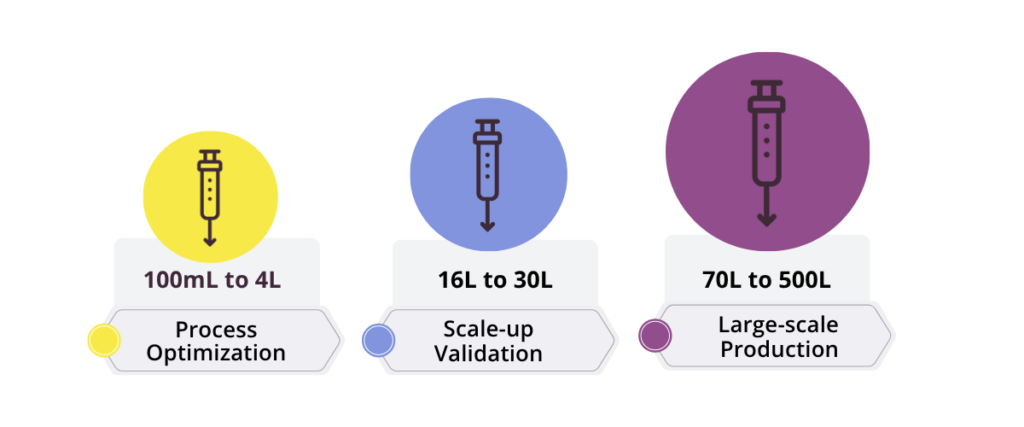
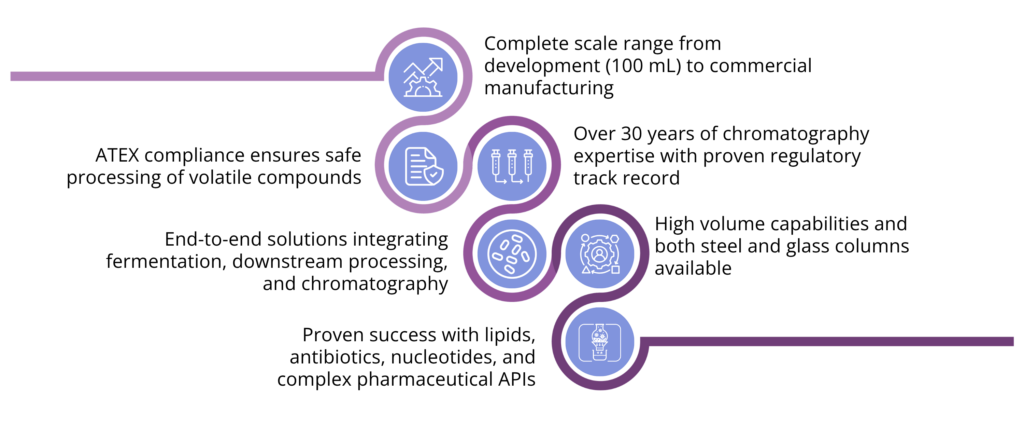
Whether you need to purify a novel lipid, optimize an antibiotic intermediate, or scale a complex API, Curia’s chromatography infrastructure supports every stage, from 100 mL development columns to 500 L commercial manufacturing. Our ATEX-compliant facilities across Spain and Italy combine decades of process expertise with cGMP-ready operations. The result: a reliable, linear scale-up pathway that accelerates your molecule from lab to market.

A Look Inside Curia’s Center of Excellence for Chromatography
Take a tour inside Rozzano’s industrial chromatography plant:
Curia Network
Industrial Chromatography Insights
Frequently Asked Questions
What is industrial chromatography and how did it develop?
At its core, chromatography is a physical method of separation in which the components of a mixture are distributed between two phases: a stationary phase (the “packing”) and a mobile phase (the “liquid”) that moves in a definite direction.
- The Origins (Early 1900s): Mikhail Tsvet, a Russian botanist, first coined the term “chromatography” while separating plant pigments on a chalk column. For decades, it remained a small-scale laboratory technique for identification rather than production.
- The Antibiotic Boom (1940s–1950s): The real shift to “industrial” scale was triggered by WWII and the desperate need for mass-produced Penicillin. Traditional crystallization wasn’t enough to reach required purity levels from messy fermentation broths. Engineers adapted lab columns into large-scale adsorption units, marking the birth of preparative chromatography.
- The HPLC Revolution (1970s): The development of High-Performance Liquid Chromatography (HPLC) allowed for much faster separations under high pressure. This transformed the “Small Molecule” world, allowing for the rapid purification of complex synthetic drugs and early peptides.
- The Biologics Era (1980s–Present): The rise of Monoclonal Antibodies (mAbs) necessitated a “gentler” industrial approach. The invention of Protein A affinity resins allowed manufacturers to “fish out” a single protein from thousands of liters of cell culture, cementing chromatography as the “gold standard” for downstream processing.
What are the main applications of chromatography in modern industry?
Beyond simple separation, industrial chromatography serves four critical functions in drug manufacturing:
- Purification (Downstream Processing): The most common application. It removes host cell proteins, DNA, and viruses from biologics, or reaction byproducts and catalysts from synthetic small molecules.
- Quality Control & Purity Analysis: Used to verify that every batch meets stringent regulatory standards. It identifies and quantifies the Active Pharmaceutical Ingredient (API) and ensures degradants are within safe limits.
- Chiral Separation: Many small molecule drugs exist as “mirrored” pairs (enantiomers). Often only one is effective while the other may be toxic. Chromatography is the industry standard for isolating the therapeutic form.
- Solvent and Resource Recovery: In large-scale small molecule synthesis, chromatography helps recover expensive or regulated solvents from waste streams, improving the environmental footprint (Green Chemistry).
How does the approach differ for Small vs. Large Molecules?
While the fundamental physics are similar, the strategic application depends on the “size” of the target.
Small molecule purification, such as for antibiotics or synthetic APIs, primarily focuses on resolving “related substances”, byproducts or isomers that are chemically almost identical to the target drug. To achieve the required >99.5% purity, industrial Reverse Phase Chromatography (RP-HPLC) is typically employed. This “workhorse” method utilizes high-pressure skids and solvent gradients to force separation based on subtle differences in hydrophobicity, ensuring high-throughput precision for large-volume synthetic batches.
In contrast, large molecule manufacturing (biologics like mAbs or viral vectors) prioritizes the “gentle” removal of complex biological contaminants like host cell proteins, DNA, and viruses without denaturing the fragile 3D structure of the protein. Instead of high-pressure solvents, these processes rely on Affinity or Ion Exchange Chromatography, which use biological “handles” to selectively capture the molecule from a dilute fermentation broth. The ultimate goal here is to maintain full biological activity while meeting the extreme purity mandates required for human injection.
What are the common types of chromatography available?
We select the technique based on the specific “handle” of the molecule:
- Affinity Chromatography (AC): The “Lock and Key” method. Highly specific; the standard for monoclonal antibodies.
- Reverse Phase (RP-HPLC): Separates by hydrophobicity. The “workhorse” for antibiotics, peptides, and small molecules.
- Ion Exchange (IEX): Separates based on charge. Essential for “polishing” steps in both segments to remove trace impurities.
- Size Exclusion (SEC): Separates by molecular size. Used to ensure large molecules haven’t “clumped” (aggregated) and for buffer exchange.
- Mixed-Mode (MMC): A hybrid using multiple interactions (e.g., charge + hydrophobicity) to solve the most difficult separation puzzles in complex new modalities.
Lab Scale vs. Industrial Scale: Does size matter?
While the chemistry remains the same, the engineering changes completely as you scale up toward 100L+ column capacity. Transitioning from laboratory column to a large industrial skid introduces several “scale-up” challenges.
Why size matters: In a large column, physics works differently than in a test tube. The sheer weight of the liquid and the resin bed can cause “bed compression.” If the resin isn’t mechanically strong, the flow will slow or stop, a phenomenon known as “blinding” the column. This is why industrial resins are engineered for mechanical rigidity. Furthermore, ensuring that liquid moves at the exact same speed in the center of a 1.5-meter wide column as it does at the edges (Flow Distribution) is the primary engineering feat of large-scale manufacturing.
What are the current market size and trends?
The global chromatography market for pharmaceuticals and biotechnology is valued at approximately $13.3 billion in 2025 and is projected to reach nearly $20 billion by 2030 (CAGR of 8.4%).
Key Trends:
- Green Chromatography: There is a heavy push to replace toxic organic solvents (like Acetonitrile) with bio-based solvents.
- Process Intensification: Moving from “Batch” to Multi-Column Continuous Chromatography (MCC). This allows for smaller columns to do the work of one giant one, reducing resin costs by up to 80%.
- The Rise of Single-Use: In many CDMOs, pre-packed, disposable chromatography columns are replacing traditional stainless steel to eliminate the need for cleaning validation and speed up changeovers. While they significantly reduce upfront capital investment and the consumption of high-purity water, they are currently characterized by higher recurring consumable costs and are often limited in scale compared to traditional hardware.
What are the advantages of outsourcing to a CDMO?
- Access to Specialized Expertise: Many newer modalities (like ADCs, bispecifics, or complex peptides) require “bespoke” purification strategies. CDMOs offer institutional knowledge from handling hundreds of different molecules.
- Capital Asset Avoidance: Building a cGMP-compliant chromatography suite costs millions. Outsourcing allows companies to convert fixed capital expenditure (CAPEX) into variable operational expenditure (OPEX).
- Speed to Clinic: CDMOs have “ready-to-use” platforms and established supply chains for resins and solvents, often shaving 6–9 months off the timeline to produce clinical trial materials.
- Scalability & Flexibility: A CDMO can quickly pivot between different scales without the sponsor needing to invest in new hardware for every phase.